
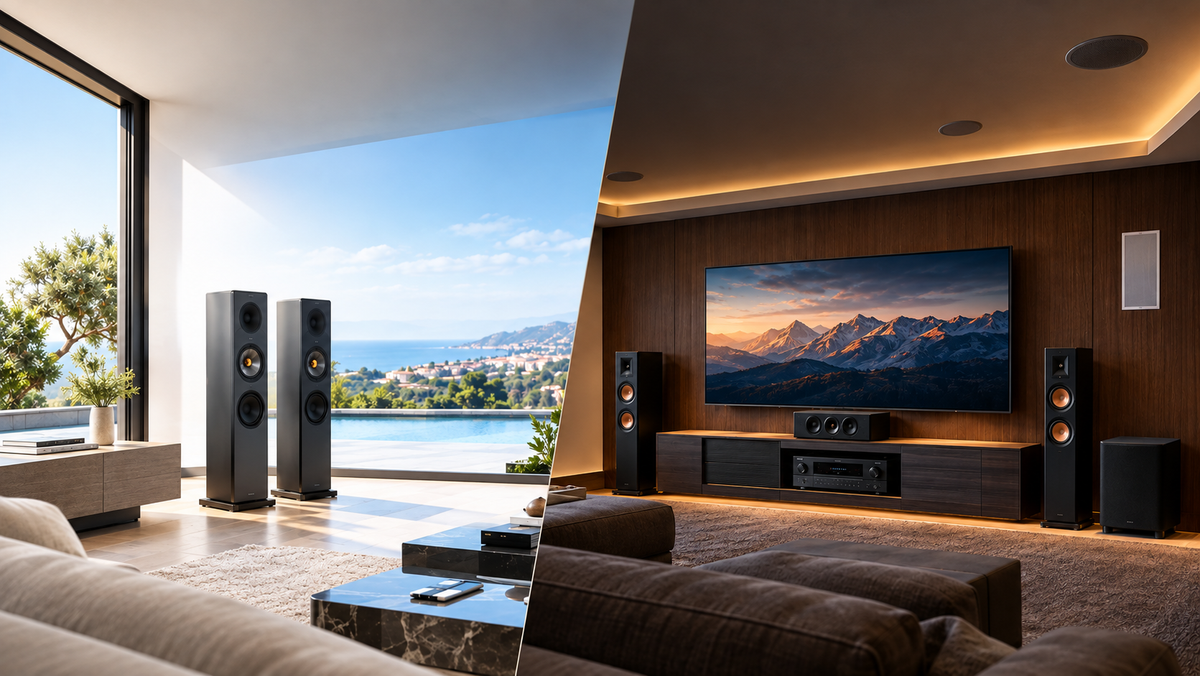
Handing over a new villa usually brings the same question within the first week: do you want speakers that need an amplifier, a rack and cabling buried in the walls, or speakers that plug into power and stream on their own?
Both routes can sound excellent. They suit very different builds and very different levels of patience for equipment in the room. The decision is easier to make early, because one option depends on conduit that has to be in place before the walls close.
Active vs passive speakers: the short comparison
|
|
Active wireless |
Passive |
|
Amplification |
Built into the speaker |
Separate receiver or amplifier |
|
Cabling |
Power and network at each speaker |
Speaker cable back to a central rack |
|
Best for |
Living rooms, studies, music |
Cinema rooms, multi-zone, ceiling speakers |
|
Upgrading |
Replace the whole speaker |
Replace the receiver only |
|
Retrofit |
Easy |
Difficult once finished |
What does "active" actually mean?
An active speaker has its amplification built in. There is no separate receiver, no speaker cable running back to a rack, and no amplifier sizing to get wrong. The manufacturer matches a dedicated amplifier to each driver and tunes the crossover digitally, which removes a layer of guesswork.
The KEF LS60 Wireless shows how far the idea has come: a full floorstanding system with 1400W split across dedicated high, mid and low frequency amplifiers per speaker, HDMI eARC for the television and hi-res streaming built in. Two power cables and a network connection replace what used to be a rack, a pair of interconnects and two runs of speaker cable.
Step down and the logic holds. The KEF LS50 Wireless II brings the same approach to a bookshelf pair with the 12th-generation Uni-Q driver and Metamaterial Absorption Technology. The KEF LSX II LT does it for a study, bedroom or desk in a cabinet just 24cm tall.
The KEF Coda W earns a separate mention for its built-in moving magnet phono stage and RCA line input, which removes the need for a separate phono preamplifier if there is a turntable in the plan.
Where the television is the centre of gravity rather than the music, the KEF XIO soundbar covers it in one unit: a 5.1.2 Dolby Atmos configuration driven by twelve Class D amplifiers totalling 820W, with Uni-Q MX drivers.
Where do passive systems still win?
Passive speakers contain no electronics. They are driven by an external amplifier or AV receiver, so you choose speakers and power separately and can change either later.
Scale. A villa cinema running seven, nine or eleven channels is not an active job. A tower pair like the Polk Signature Elite ES60 or the compact ES50 anchors the front stage, with Monitor XT20 or Monitor XT15 as surrounds and the wall-mountable Signature Elite ES10 for height channels.
Processing. Object-based decoding, room correction and multi-zone distribution live in the receiver. A Denon AVR-X2800H handles 7.2 at 95W per channel. The AVC-X3800H and AVC-X4800H move to 9.4 channels with four subwoofer outputs, and the AVR-X6800H runs 11.4 channels at 140W.
Upgrade path. Speakers in walls and ceilings stay for fifteen years. Electronics do not. Passive lets you replace the brain without touching a finished ceiling, which is the strongest argument for it in a property you intend to keep.
Which system suits which room?
Most villas are not one decision, they are five.
- Living room: active, unless it doubles as the cinema. A pair of LS60 Wireless or LS50 Wireless II keeps the room clear.
- Cinema room: passive, always. Channel count and room correction decide the result here.
- Majlis: ceiling speakers on a multi-zone amplifier, so nothing interrupts the interior design.
- Bedrooms and study: active, one pair per room, grouped over the network. Terrace, garden and pool: passive weatherproof speakers on a distributed amplifier.
The cabling decision happens at first fix
An active system needs a power socket and ideally a network point at each speaker position. A passive system needs speaker cable from every position back to a central rack, plus a ventilated cupboard with power and cooling.
Neither is difficult. Both are expensive to retrofit into finished marble and gypsum. If the villa is still at first fix, pulling cable for both options costs very little and preserves the choice.
What is the real risk with an active wireless system?
The network. Active speakers depend on Wi-Fi or Ethernet for streaming and for talking to each other, and villa Wi-Fi in this region is frequently the weakest part of the whole house. Thick concrete, long floor plans and a single router in the wrong place cause dropouts that get blamed on the speakers.
Run a cabled network point to each speaker position where you can, and treat Wi-Fi coverage as part of the audio specification rather than a separate IT job.
One further point on imported equipment: check the voltage rating. Electronics built for the North American market run on 120V and will be damaged on a 220V supply without a step-down transformer.
Bass is where most villas get it wrong
Large open-plan rooms with marble floors, glass walls and double-height ceilings are unforgiving. Low frequencies build in corners and disappear in the middle of the room, which is why a system that sounded excellent in a showroom sounds thin at home.
Plan for a subwoofer from the start. The KEF Kube 8 MIE uses an 8-inch driver and 300W Class D amplifier in a sealed cabinet with placement presets for free-standing, in-cabinet and corner positions. For larger rooms, the Kube 10b has more output. Both need a line-level cable, so that conduit belongs in the plan.
What does each cost over ten years?
Active usually costs less on day one because there is no receiver, no rack and less cable. Passive often costs less over a decade because you replace one receiver rather than an entire speaker system when HDMI standards move again.
There is also resale. In-wall and in-ceiling speakers stay with the property and read as a fitted feature at handover. Active speakers leave with you. Which of those you prefer depends on whether this is the long-term home or the next five years.
Neither is the cheap option. The expensive option is the one installed twice.
A simple way to decide
Choose active if the villa is built or close to handover, you want a clean room with minimal visible equipment, and music matters more than a full cinema.
Choose passive if you are still at first fix, you want ceiling or in-wall speakers across several zones, or you are building a dedicated cinema room.
Most villas end up with both: an active pair in the living room, and a passive receiver-driven system in the cinema and distributed zones.
Frequently asked questions
Do active speakers sound better than passive?
Neither category is better. Active removes amplifier matching from the equation, which helps at lower budgets. At the top end, results depend on the specific speakers, the room and the setup.
Can I mix active and passive in one house?
Yes, and most villas do. Group them for whole-home playback over AirPlay 2, Chromecast or a control system.
Do active speakers need an amplifier?
No. Amplification is built in. They need power at each speaker and a network connection.
Are wireless speakers really wireless?
Not entirely. Each speaker needs mains power, and many pairs connect to each other by cable. Wireless refers to the source connection.
How much should I budget for a villa audio system?
It depends on zone count more than anything. Price the number of rooms, then the specification within them, not the other way round.
When should I involve an AV company?
At first fix, before the walls close. Involving us at handover limits the options to whatever can be retrofitted without damage.
If you are at that stage, our residential audio visual and home cinema and acoustics teams can review the drawings with you before anything is fixed. Start your project here.


