
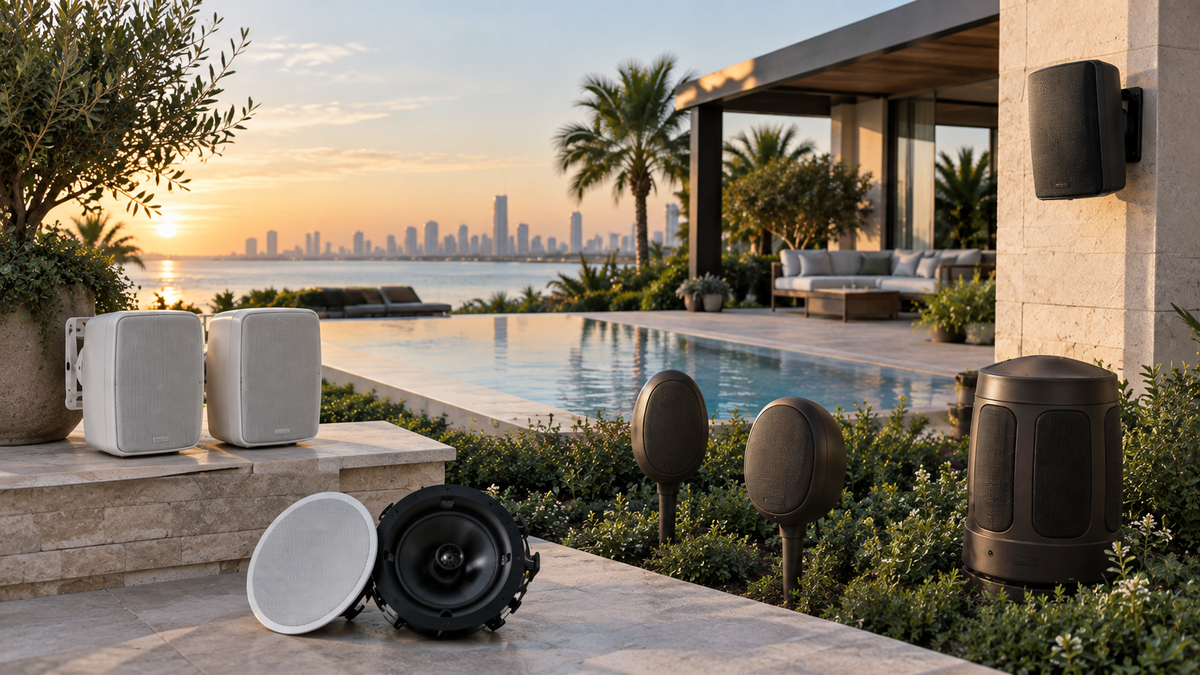
TruAudio builds speakers for installers rather than for shelves. The company grew out of a home electronics integration business that installed thousands of home theatres and multi-room systems, and it shows: tool-free mounting, weatherproof housings and 70V options that make a fifteen-speaker garden run practical rather than painful.
That matters here, where the difficult jobs are rarely the living room. They are the garden in July, the rooftop terrace, the pool area and the ceiling void that turned out to be 90mm deep.
Which TruAudio speaker suits which space?
|
Space |
Model |
Why |
|
Ceilings, indoors |
Angled 6.5in LCR, aimable at seating |
|
|
Terrace, balcony, pergola |
Wall-mount, passive radiator, QuickLock |
|
|
Garden beds and borders |
Staked satellites that disappear into planting |
|
|
Lawns, walkways |
360 degree, no aiming required |
|
|
Large estates, hospitality |
70V for long runs and many speakers |
In-ceiling speakers: sound with nothing in the room
Ceiling speakers are the default across most villas here because they leave the interior design untouched.
The TruAudio R65 is an angled 6.5-inch in-ceiling LCR with a polypropylene woofer and silk dome tweeter. The angle is the entire point. A flat ceiling speaker fires straight at the floor, which is fine for background music and poor for anything else. An angled driver can be aimed at the seating position, so dialogue appears to come from the screen rather than from above your head.
In a majlis or high-ceilinged living room, that difference decides whether the system sounds installed or sounds like an afterthought.
Ceiling speakers need decisions at first fix, not second. Void depth, back boxes, insulation and separation from the slab all change the result, and in concrete construction the cut positions need agreeing with the contractor before the ceiling closes. Our residential audio visual team handles that stage with the main contractor directly.
Outdoor wall-mount speakers for terraces and pool houses
The TruAudio OP6 pairs a 6.5-inch polypropylene woofer with a 1-inch aluminium coaxial tweeter and a bass-enhancing passive radiator. The passive radiator matters outdoors: it recovers low frequency output that would otherwise disappear into open air, without a vent that collects dust and water.
Its QuickLock mounting lets the installer terminate the wire at the bracket, hang the speaker, adjust the angle and lock it with a lever. Across twelve speakers on three elevations, that saving is real. Black or white, to suit the wall rather than fight it.
Landscape speakers for gardens and open spaces
Open gardens are a different engineering problem. No walls, no ceiling and nothing to reflect sound back, so a pair of loud speakers at one end does not work. Guests near them get too much and guests at the far end get nothing.
The answer is more speakers playing quietly, distributed through the planting. The AS-2 and AS-3 are staked satellites that vanish once planting matures. The AS-360 radiates 360 degrees from three 1-inch silk dome tweeters and a down-firing 6.5-inch driver, which removes aiming entirely and suits a central lawn or a walkway. All AcoustiScape models use a natural bronze UV-stable housing, switch between 8 ohm and 70V, and ship with a ground stake.
As a rough planning figure, budget one satellite every four to six metres around a seating area rather than two loud speakers at the boundary.
Will outdoor speakers survive a Gulf summer?
This is the question worth asking before any model choice. Three things kill outdoor audio here: UV, heat and salt.
UV degrades plastics and fades finishes, which is why the UV-stable housings across the AcoustiScape range matter more in Dubai than in most markets. Heat in a sealed enclosure ages components faster, so speakers should not sit in direct afternoon sun where shade is available. Salt air on coastal and island properties corrodes fixings and terminals, so stainless hardware and sealed connections are not optional there.
Cabling matters as much as the speaker. Use direct burial rated cable in conduit, never standard indoor speaker wire, and seal every connection in a proper gel-filled or heat-shrink joint. Most outdoor audio failures we are called to repair are connection failures, not speaker failures. Our repairs and AMC team sees the same fault repeatedly.
8 ohm or 70V: which should you use?
Getting this wrong is the most common reason outdoor audio underperforms.
On a standard 8 ohm system, each speaker presents a load to the amplifier, cable runs must stay relatively short, and adding speakers eventually drops the impedance to a point the amplifier cannot handle safely.
On a 70V system, each speaker carries a small transformer with selectable power taps. You can run a long chain from one amplifier over thinner cable across long distances, and set each speaker's volume individually at the tap. That is how large gardens, compounds, rooftops and hospitality landscapes get wired without an amplifier every twenty metres.
Four to six speakers on a short run: 8 ohm is simpler and sounds fine. Beyond that, or across multiple zones: 70V.
To size a 70V amplifier, add the tap settings of every speaker on the line and add roughly twenty percent headroom. An amplifier run at its limit distorts and overheats, which outdoors means it does both in August.
Do you need permission for outdoor audio?
Many villa communities and all hotel operations have noise limits, particularly after evening hours. That is an argument for distributed low-volume systems rather than fewer, louder speakers, and for volume ceilings set in the amplifier rather than left to whoever holds the remote. Our hospitality team sets those limits per zone as standard.
What sits behind the speakers?
TruAudio speakers are passive, so they need amplification and control. In a villa that usually means a multi-zone amplifier tied into the home automation system, so garden, terrace, pool and majlis appear as named zones on a keypad or app rather than unlabelled dials in a cupboard.
Frequently asked questions
Are TruAudio speakers available in the UAE?
Yes. We stock and install the range across Dubai and the wider UAE. Models beyond those listed online can be supplied on request.
Can TruAudio speakers be left outdoors year-round?
The outdoor and landscape models are built for it, with UV-stable weatherproof housings. Longevity depends as much on cable, connections and mounting hardware as on the speaker itself.
How many outdoor speakers do I need?
More than most people expect. Plan one satellite every four to six metres around seating areas, playing at moderate volume, rather than two loud speakers at one end of the garden.
What is the difference between 8 ohm and 70V?
8 ohm suits short runs with a handful of speakers. 70V allows many speakers on one long cable run with individual volume taps, which is the right choice for large gardens and commercial spaces.
Do I need a subwoofer outdoors?
Often yes. Bass disperses into open air with nothing to reinforce it, so a buried or hardscape subwoofer restores weight that satellites alone cannot produce.
Can these be used on a yacht?
Marine environments need salt-rated hardware and careful sealing. Speak to our yacht and marine team before specifying anything.
Outdoor audio is a coverage exercise before it is a product choice. Browse the range on the TruAudio brand page, or send us your site plan and we will mark up a layout.


