
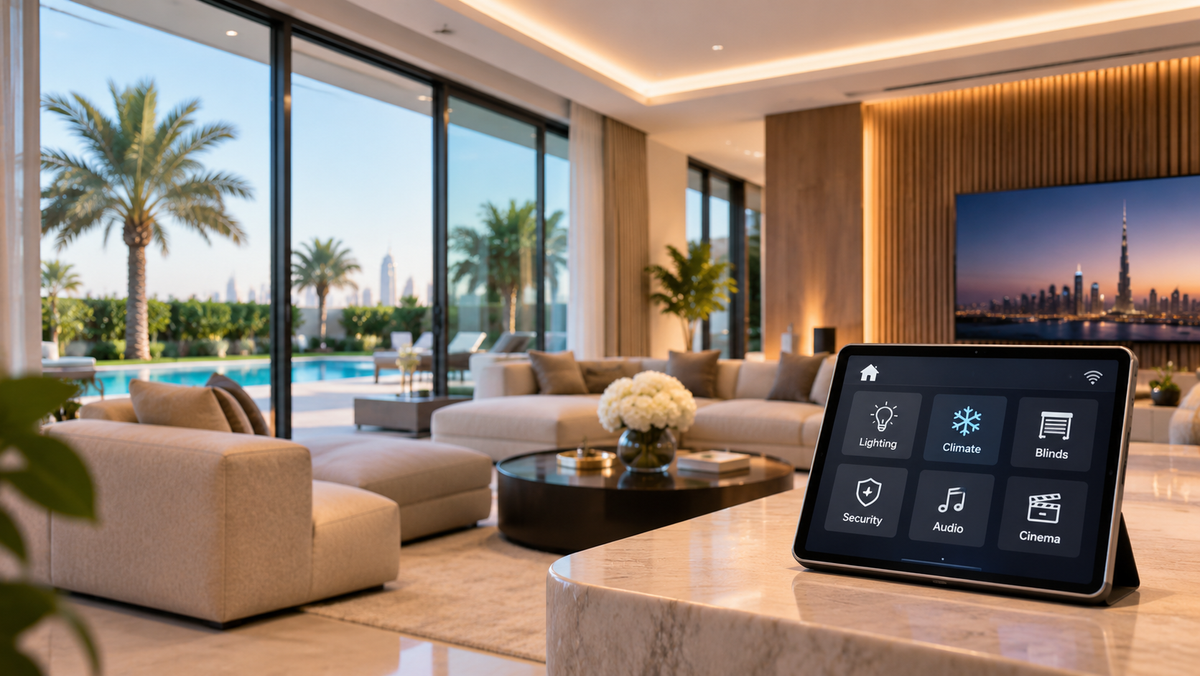
Is a smart home worth it? It is one of the most common questions we hear from villa owners and apartment buyers in Dubai. The answer is yes, with one condition. A smart home is worth it when it solves problems you actually have: high cooling bills, a large property that is hard to secure, too many switches on every wall. It is not worth it when it becomes a collection of gadgets that each need their own app.
The difference comes down to order. What you automate first, and whether each new piece builds on the last, decides whether you end up with a home that runs itself or a drawer of devices that never quite worked together.
What does a smart home actually cost?
Smart home costs vary more than almost any other home upgrade, because “smart home” covers everything from a few smart plugs to a fully wired villa. Four things decide where a project lands:
-
Wired or wireless. Wired systems such as KNX are planned at first fix and are the most reliable over the long term. Wireless systems are easier to retrofit into a finished property.
-
Number of rooms and control points. Every light circuit, blind, AC unit, sensor and keypad adds to the count.
-
Which systems are included. Lighting and climate alone cost far less than lighting, climate, security, audio and cinema together.
-
Design and programming. The hardware is half the job. Designing scenes that make sense to the whole family is the other half.
As a guide, typical smart home costs across the Dubai market fall into four broad tiers:
|
Property and scope |
Typical range (AED) |
|
Studio or 1-bed apartment: smart AC control, a few lighting circuits, smart lock |
2,500 to 5,000 |
|
2 to 3-bed apartment or townhouse: full lighting, climate, blinds, lock and cameras |
8,000 to 45,000 |
|
Villa with a wired KNX backbone: lighting, blinds, climate and security throughout |
45,000 to 150,000 |
|
Large luxury villa: full automation plus multi-room audio and a home cinema |
150,000 and above |
Where a property sits within each range depends on the four factors above. Two villas of the same size can differ widely in cost depending on how many rooms are automated and whether the wiring went in at first fix.
The cost people forget is support. Firmware updates, a router swapped by the internet provider, a new phone that needs setting up: a smart home needs occasional attention. That is what an annual maintenance contract covers, keeping the system working the way it did on handover day. Most of the smart home cost mistakes we see in Dubai come from skipping support and planning, not from the hardware itself.
Where a smart home pays off in the UAE
This is where the answer to “is a smart home worth it” becomes clearest.
Climate control : Air conditioning runs for most of the year here and is usually the biggest item on the electricity bill. Schedules, occupancy sensing and automatically switching off empty rooms deliver savings you can actually measure.
Security and peace of mind : Many residents travel for weeks in summer. Cameras, smart locks and a video door phone you can answer from anywhere turn an empty villa from a worry into something you can check in seconds.
Lighting : Scenes such as “evening”, “movie” and “away” replace a wall of switches. They make a large villa far easier to live in, especially for guests and older family members.
Comfort : Blinds that close against the afternoon sun, music that follows you from room to room, and a cinema that sets itself up with one button.
When a smart home is not worth it
Automation is not always the right call. It rarely pays off if:
-
You plan to move within a year and the system cannot come with you.
-
The network is unreliable and you are not prepared to fix it first.
-
Nobody in the household wants to use it. A system the family ignores is wasted money.
-
It is built from mismatched devices with no plan for how they work together.
Each of these can be solved, but they are worth naming honestly before you spend anything.
What should you automate first?
1. The network
Every smart device depends on it. Weak Wi-Fi is the single most common reason a smart home feels unreliable, and in villas with thick concrete walls it is often the weakest part of the house. Fix Wi-Fi coverage across the villa before buying anything else.
2. Climate and lighting
These are the systems you use every day and the ones that pay you back. Start with the rooms you spend the most time in, then extend room by room.
3. Security
CCTV cameras, smart door locks and a video door phone belong on the same platform as your lighting. That way, one “away” scene arms the cameras, locks the doors and switches off the lights together.
4. Audio and entertainment
Multi-room music comes next, with streaming amplifiers such as VSSL driving ceiling speakers. Add a home cinema scene that dims the lights and lowers the screen.
This order matters more than any single product. Each step relies on the one before. Start with entertainment on an unreliable network and you end up with a frustrating system, whatever it cost.
Choose the platform before the devices
Mixing ecosystems is how a home ends up with six apps and nothing that talks to anything else. Decide on the backbone first, then buy devices that work with it. KNX suits new builds and major renovations. For wireless systems, the choice between Zigbee, Z-Wave, Thread and Wi-Fi decides which devices you can add later, so settle it before buying anything.
Apartment or villa: different starting points
Apartments suit wireless systems focused on climate, lighting and a smart lock. They are removable, so the system can move with you if you rent.
Villas, especially at first fix, suit wired infrastructure for lighting, blinds and climate, with wireless devices only where needed. Running cable before the walls close costs very little. Retrofitting the same thing into finished marble and gypsum costs a great deal.
Frequently asked questions
How much does a smart home cost in Dubai?
Typically from around AED 2,500 for a basic apartment setup to AED 150,000 and above for a fully automated luxury villa. The number of rooms, wired or wireless infrastructure, and which systems are included make the biggest difference.
Is a smart home worth it for renters?
Yes, if you choose wireless devices you can take with you, such as smart thermostats, plugs, bulbs and locks.
Does a smart home save money on DEWA bills?
Climate automation is where the savings are, because air conditioning dominates usage. Scheduling and switching off empty rooms make a measurable difference.
What is the best smart home system for a villa in Dubai?
For a new build, a wired backbone such as KNX is the most reliable over decades. Wireless suits retrofits and apartments.
Can I add to a smart home later?
Yes, if you chose an open platform from the start. That is why the platform decision comes before the devices.
Do smart homes stop working without internet?
Well-designed systems keep local control of lighting and climate when the internet is down. Ask about this before you buy.
So, is a smart home worth it? Done in the right order, on the right platform, yes. Well-planned home automation in Dubai earns its place in the first summer, through lower cooling bills and a villa you can check on from anywhere.


