
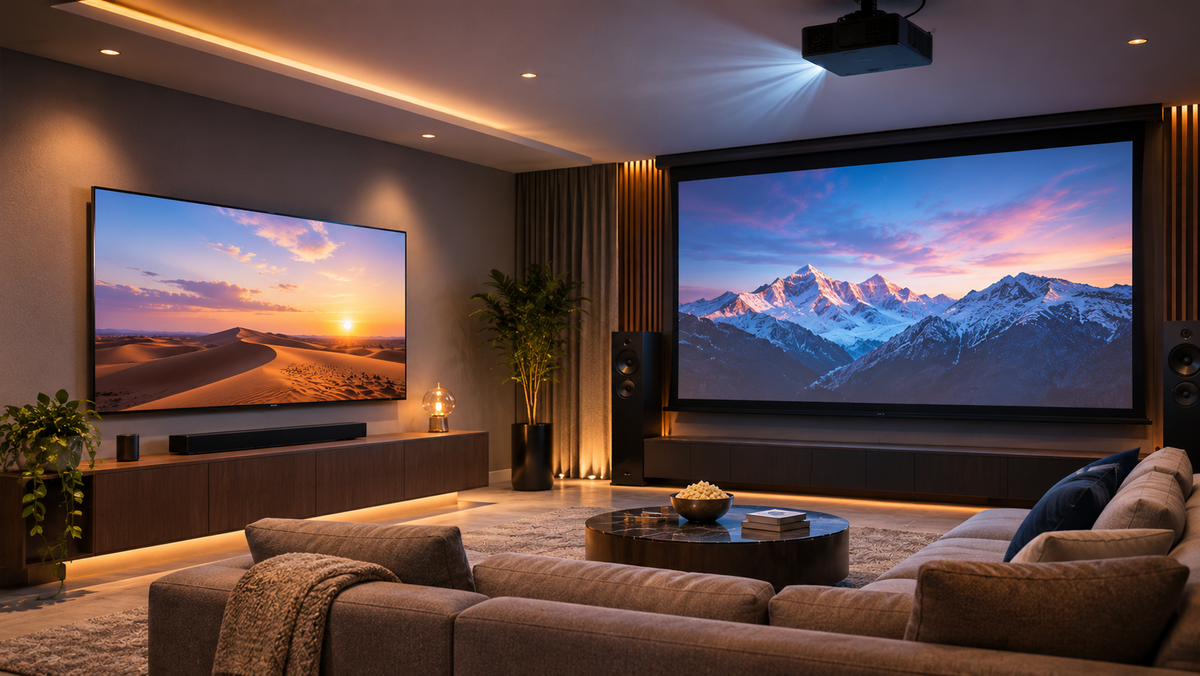
It is the first question in almost every home cinema project we design in Dubai: projector vs TV? The honest answer depends less on the technology than on the room. A projector in a bright living room is a disappointment. A TV in a dedicated cinema room is a missed opportunity.
Three questions usually settle the projector vs TV decision. How big do you want the picture? How much light does the room get? And what do you mostly watch? This guide works through each one, then covers cost and installation, and explains why most villas don’t choose between a projector or TV at all.
Projector vs TV: the short comparison
|
|
Projector |
TV |
|
Image size |
100 to 150 inches and beyond |
Typically up to about 100 inches |
|
Daylight viewing |
Weak unless light is controlled |
Strong |
|
HDR highlights |
Lower brightness |
Much brighter |
|
Cost at very large sizes |
Lower |
Rises steeply above 85 inches |
|
Installation |
Screen, mount, cabling, blinds |
Wall mount and power |
|
Cinema feeling |
Strong |
Limited |
Screen size: where projectors win
Beyond about 85 inches, TV prices climb steeply and the choice of models narrows. A projector reaches 120, 135 or 150 inches for considerably less. At those sizes the picture fills your field of view. That is what makes a film feel like an event rather than another evening of television.
Size still has to match the seating. The screen should fill a comfortable part of your vision without forcing you to turn your head to follow the action. In a small room, a very large screen is tiring rather than cinematic. That is why projector screen sizing should start from the seating distance, not from the biggest screen the wall will take.
Brightness and room light: where TVs win
A TV produces its own light. A projector reflects light off a screen, so every other light source in the room competes with the image. In a Dubai living room with floor-to-ceiling glazing, a projector at three in the afternoon looks washed out. A good TV does not.
Two technologies narrow the gap. Ambient light rejecting (ALR) screens absorb light arriving from above and the sides while reflecting the projector’s light towards the audience. Ultra-short-throw projectors sit on a low unit just below the screen, so nobody walks through the beam. Neither turns a sunlit room into a cinema. Together, with decent blinds, they make a projector workable in a living room.
HDR is the other area where TVs lead. Bright highlights, such as sunlight on water or a muzzle flash in a dark scene, come across with far more intensity on a modern TV than through a home cinema projector.
Picture quality: contrast, blacks and detail
In a properly darkened room, a good projector produces a very convincing picture. High-end laser projectors from JVC deliver deep blacks and strong native contrast, which is why they remain the choice for dedicated cinema rooms.
OLED TVs, by comparison, switch off individual pixels and show true black in any lighting. In a mixed-use room that is never fully dark, that is a real advantage. The fair summary: a TV wins in changing light, and a projector wins on scale once the light is under control.
What you watch decides more than specifications
-
Mostly films, in the evening: projector.
-
News, daytime sport and children’s programmes: TV.
-
Gaming: generally a TV, for brightness and low input lag, although many current projectors offer fast game modes.
-
Big matches with friends: a projector is unbeatable for atmosphere, if the match is after dark.
If one room has to do everything, the TV is the safer default. If you have a room that can be given over to films, the projector is the better home cinema experience.
Projector vs TV cost
Up to around 75 inches, a TV is usually the cheaper route. Beyond 85 inches the comparison flips. A 100-inch TV is a premium product, while a projector and screen at the same size usually cost less, and the gap widens as the screen grows.
Count the full cost on both sides. A projector needs a screen, a mount, cabling and often motorised blinds. A TV needs a wall mount and power. Both need proper sound, because neither built-in TV speakers nor a projector’s own speaker will do justice to a film. Laser projectors have removed the old running cost of replacement lamps.
Installation and room requirements
A TV can go on almost any wall. A projector needs more planning: the throw distance between projector and screen, cable routes to the ceiling, ventilation, and light control at the windows. In a new villa, all of this is easiest at first fix, before the ceilings close. In a finished property, an ultra-short-throw projector avoids most of the ceiling work.
The answer for most villas: both
Most of our villa projects don’t settle projector vs TV with a single answer. The family room gets a large TV for everyday viewing. A dedicated cinema room, basement or converted majlis gets a projector and a proper screen. It also gets acoustic treatment to stop sound travelling through the house, and cinema recliners that make a three-hour film comfortable.
In that room, light control is easy and the projector is clearly the better experience. Planning a home theatre for a villa this way also means cabling, ventilation and blackout are all handled at first fix.
Do not forget sound
The display is only half of home cinema. For a living room built around a TV, a Dolby Atmos soundbar such as the KEF XIO is a clean single-box upgrade.
For a dedicated projector room, an AV receiver like the Denon AVC-X3800H with separate speakers is the right foundation. The difference between Denon AVR and AVC models is smaller than the prefix suggests.
Frequently asked questions
Is a projector better than a TV for home cinema?
For large images in a room with controlled light, yes. For bright rooms and daytime viewing, a TV is the better choice.
Can I use a projector in a room with windows?
Yes, with blackout blinds or curtains, ideally motorised and linked to a lighting scene. An ALR screen helps but does not replace light control.
Which is cheaper, a projector or TV?
Below about 75 inches, usually the TV. At 100 inches and above, usually the projector, even after adding a screen.
Projector vs TV for gaming: which is better?
A TV in most cases, for brightness and input lag. Some projectors now have fast game modes that close the gap.
Do projectors last as long as TVs?
Modern laser projectors are rated for many thousands of hours and have no lamp to replace.
Still weighing up projector vs TV for your room? Seeing both side by side settles it faster than any specification sheet, which is exactly what our Al Quoz showroom is for.


