
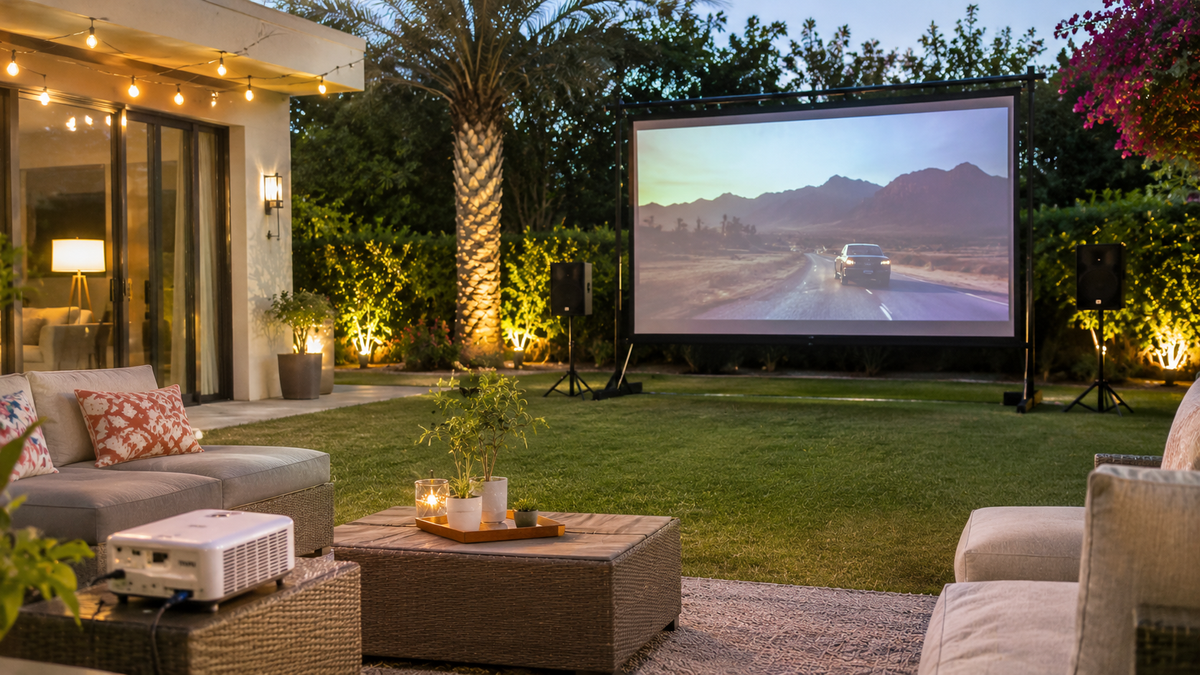
For about five months a year, the garden is the best room in a Dubai villa. From roughly November to March the evenings turn cool, the humidity drops, and the sun sets around 5:30 to 6pm through December and January. That long, dark evening is exactly what an outdoor cinema needs.
Setting up an outdoor cinema in Dubai is not complicated, but it is easy to get wrong. Most disappointing garden movie nights fail for the same four reasons. The projector is too dim for the surrounding light, the screen ripples in the breeze, the sound disappears into open air, or there is no power or network where the equipment needs to go. Get those four right and the rest is popcorn.
What do you need for an outdoor cinema at home?
At its simplest, an outdoor cinema at home needs five things:
-
A projector bright enough for your garden
-
A screen that stays flat and taut
-
Speakers placed close to the audience
-
Weatherproof power near the screen and the seating
-
A reliable network connection for streaming
Blankets, bean bags and lighting scenes all make the evening better. But these five decide whether the film is actually watchable. The sections below take each one in turn.
How bright does an outdoor projector need to be?
Brighter than you think, but not for the reason most people assume. After sunset the garden itself is dark. What competes with the image is everything else: pool lights, landscape uplighters, the neighbour’s terrace, a lit façade and the glow of the city.
A projector that looks superb in a blacked-out cinema room can look washed out in a lit garden. An outdoor projector needs real brightness headroom above what the same screen size would need indoors. Before buying anything, hold a test evening. Switch off every light you control, and shield or angle the ones you cannot.
The light source matters too. A laser projector reaches full brightness almost instantly and has no lamp to replace halfway through the season. Short-throw models help in compact gardens where there is little space between projector and screen.
If the same projector will also serve your indoor cinema room, a laser projector is the better long-term choice. Indoors or out, choosing the right projector comes down to brightness, throw distance and contrast far more than headline resolution.
Choosing an outdoor movie screen
The outdoor movie screen does as much for picture quality as the projector. There are three realistic options:
-
Inflatable screens go up for the evening and pack away into a bag. They suit occasional use, but large inflatables catch the wind and need proper anchoring.
-
Tensioned frame screens, freestanding or fixed to a structure, stay perfectly flat. This is the right choice if garden movie nights will become a habit.
-
A painted wall is the cheapest route and the least convincing. Render texture, colour and joints all show through the image.
Wind is the hidden problem. Even a light evening breeze makes an untensioned screen ripple. That ripple is far more distracting on screen than it looks in daylight. Position the screen where a wall, hedge or the villa itself shelters it.
Screen gain matters as well. A higher-gain surface reflects more light towards the audience, which helps a modest projector, but it narrows the best viewing angle. The same principles apply when choosing the best projector screen for an indoor room. For a permanent outdoor movie screen, the frame, tensioning and fixings should be specified together with the projector and screen as one system, not bought separately.
Why sound is harder outside than inside
Indoors, walls and ceilings reflect sound back to you. Outdoors, nothing does. Sound spreads in every direction and loses energy quickly with distance. A pair of speakers that fills a living room sounds thin across a lawn. Most outdoor cinema setups need more speaker than people expect, placed differently.
Four rules help:
-
Put the speakers close to the audience, not beside the screen. A slight offset between picture and sound matters far less than clear dialogue.
-
Use outdoor speakers built for the climate. Winter dew, summer humidity, sand and dust are hard on indoor speakers. That is why weatherproof outdoor speakers rated for UAE conditions are worth the difference.
-
Add a subwoofer. Without walls to reinforce it, bass is the first thing lost outdoors, and bass is what makes a film feel like a film.
-
Aim the sound at the seating, not down the garden. Angled correctly and played at a sensible level, speakers carry far less to the neighbours.
Check your community or building rules on evening noise before the first big night. In a permanent setup, outdoor speakers for villas and gardens can be built into planters, walls and landscaping and aimed precisely at the seating. That keeps the sound full where you sit and modest at the boundary wall.
Power and network: the part people forget
A projector, a streaming source, an amplifier and powered speakers all need electricity. Extension cables across a damp lawn are not a safe answer, especially on winter evenings when the grass is wet with dew. Weatherproof outdoor sockets near the screen and the seating solve this properly. They are simple to add during landscaping works.
Streaming needs a network too. Garden Wi-Fi in most villas is weak because the signal has to pass through concrete and glazing. A film that buffers every ten minutes ends a garden movie night quickly. An outdoor-rated access point, or a cabled connection to the source, solves it. Planning villa-wide Wi-Fi coverage that reaches the garden, pool and terrace pays off well beyond movie night.
Temporary setup or permanent outdoor cinema?
A temporary setup works if you host a handful of movie nights each season. Bring the projector out, put up the screen, run the speakers, and pack everything away afterwards. Be honest about the setup time. A forty-minute setup quietly turns monthly movie nights into twice a season.
A permanent outdoor cinema makes sense if the garden is where the family actually spends winter evenings. That usually means a fixed or retractable outdoor movie screen, weatherproof speakers built into the landscaping, outdoor power and network, and lighting on a scene. Tied into home automation, one “movie” button can dim the lights, lower the screen and start the system.
One rule applies either way: bring the projector inside after use. Winter brings dew and early-morning humidity, and dust settles quickly. Projectors are not designed to live outdoors unless they are installed in a ventilated, weatherproof enclosure.
Frequently asked questions
Can I use my indoor projector for an outdoor cinema?
Yes, for the evening, if it is bright enough for your garden lighting. Bring it back inside afterwards to protect it from dew and dust.
What size outdoor movie screen should I get?
Size the screen to your seating distance and your projector’s brightness. A screen too large for the projector looks dim and flat.
Do I need a subwoofer for an outdoor cinema?
For films, yes. Open spaces lose bass quickly because there are no walls to reinforce it.
When is the best time for an outdoor cinema in Dubai?
Roughly November to March, when evenings are cool and the sun sets early.
Will Bluetooth speakers work?
For casual viewing, yes. Bluetooth can drift slightly out of sync with the picture, and portable speakers rarely have the output to fill a garden.
A permanent outdoor cinema in Dubai is best designed the same way as an indoor home cinema: around the space, the light and the people using it, with the neighbours considered from the start. Get that right, and the garden becomes the room everyone heads to as soon as the evenings cool down.


