
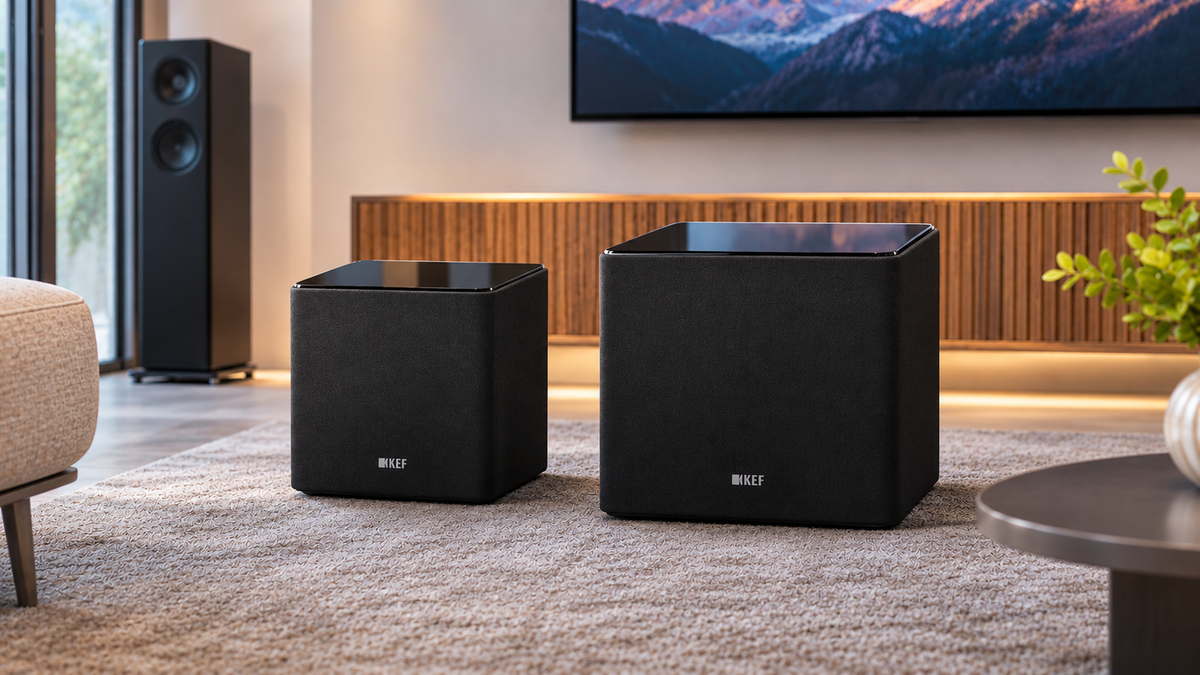
If you are adding bass to a KEF system, the Kube 8 MIE vs Kube 10b decision usually comes down to one thing: the size of your room. The two subwoofers share the same amplifier, the same DSP and the same connections. What changes is the driver and the cabinet around it. That changes how low each one reaches and how much air it can move.
This guide compares the KEF Kube 8 MIE and the Kube 10b, sold as the Kube 10 MIE, on specification, room size, placement and system pairing. The aim is to help you choose the right KEF subwoofer for your room in Dubai.
What the Kube 8 MIE and Kube 10b have in common
Both use the same 300W Class D amplifier and KEF’s Music Integrity Engine, the in-house DSP that tunes each model to its driver and cabinet. Both are sealed designs, which favours tight, accurate bass and allows the subwoofer to sit inside a cabinet. Both sit in the middle of KEF’s subwoofer line-up, between the compact KC62 and the larger Kube 12 MIE and Kube 15 MIE.
Both also connect the same way, through KEF SmartConnect and speaker-level inputs. That means they work with an AV receiver, a stereo amplifier, a soundbar or KEF’s own wireless speakers. The optional KW1 adapter removes the cable between your system and the subwoofer. A second KW1 receiver lets two KEF subs run from a single transmitter.
Kube 8 MIE vs Kube 10b: the key differences
|
|
||
|
Driver |
8-inch |
10-inch |
|
Amplifier |
300W Class D |
300W Class D |
|
Low-frequency extension |
34Hz |
24Hz (±3dB) |
|
Dimensions |
293 × 293 × 310mm |
370 × 353 × 370mm |
|
Weight |
9.4kg |
17.4kg |
|
Price |
[ADD: Kube 8 MIE price in AED] |
AED 3,885 |
The headline difference is bass extension. The Kube 10 MIE reaches down to 24Hz, while the Kube 8 MIE is rated down to 34Hz. The Kube 8 is also considerably smaller and about half the weight. That matters when it has to fit inside joinery or a TV unit.
Why the extra 10Hz matters
The region between 24Hz and 34Hz is where film soundtracks put their deepest effects: engine rumble, explosions, thunder, the low hum under a tense scene. In music, it is where pipe organs, film scores and electronic bass lines reach their lowest notes. A larger driver in a larger cabinet simply moves more air down there.
There is a twist in smaller rooms. Enclosed rooms naturally reinforce the lowest frequencies, an effect known as room gain. In a bedroom, study or compact apartment living room, the Kube 8 MIE will sound deeper than its specification suggests. In a large open-plan space, room gain largely disappears, and the Kube 10’s extra extension becomes clearly audible.
Choosing the right subwoofer for your room size
Room size is the deciding factor when choosing a KEF subwoofer, and these two split neatly:
|
Room |
Recommendation |
|
Bedroom, study or small apartment living room |
Kube 8 MIE |
|
Apartment living room, mainly music |
Kube 8 MIE |
|
Apartment living room, mainly films |
Kube 10 MIE |
|
Large villa living room, open-plan space or majlis |
Kube 10 MIE |
|
Dedicated home cinema |
Kube 10 MIE, ideally two |
Choose the Kube 8 MIE if the subwoofer has to disappear inside furniture, if you are adding weight to compact speakers mainly for music, or if you live in an apartment and would rather not share deep bass with the neighbours.
Choose the Kube 10 MIE if the room is large, the ceiling is high, or films are the priority.
Large room? Two subwoofers beat one bigger one
Marble floors, glass walls and double-height ceilings make bass uneven. Low frequencies build up in corners and cancel out in the middle of the room, so one seat booms while the next sounds hollow.
Two subwoofers in different positions even this out across the seating far better than one larger unit. That is why receivers such as the Denon AVC-X3800H offer four subwoofer outputs. In a difficult room, two Kube 8 MIEs can outperform a single Kube 10 MIE while staying compact enough to hide.
The cause is the acoustics of the room, not the subwoofer. That is why moving or adding a sub fixes what turning one up never will.
Which KEF speakers do they pair with?
The Kube 8 MIE is the natural partner for compact speakers like the KEF LSX II and the smaller LSX II LT, where a compact sub keeps the system in proportion with the room. With the KEF LS50 Wireless II, either works, and room size decides.
For films, the Kube 10 MIE is the better match. It suits the KEF XIO soundbar in a living room, and full AV systems on a Denon receiver, where one or two Kube 10s fill in the lowest octave a soundtrack demands.
Placement tips
-
Start near the front of the room, close to the main speakers, so the bass blends with them.
-
Try the subwoofer crawl. Put the sub at your seat, play bass-heavy music, and move around the room at floor level. Where the bass sounds smoothest is where the sub should go.
-
Use the matching placement preset if the Kube 8 MIE is in a cabinet or a corner.
-
Run room correction afterwards on your receiver or wireless speakers.
Frequently asked questions
Is the Kube 10 much louder than the Kube 8?
Both use the same 300W amplifier. The Kube 10’s larger driver and cabinet let it reach deeper and move more air in the lowest octaves, which matters most in large rooms.
Kube 8 MIE vs Kube 10b: which is better for music?
In small and medium rooms, the Kube 8 MIE blends easily and is often all you need. In large rooms, the Kube 10 adds depth you will hear on orchestral and electronic music.
Can I hide a Kube inside a cabinet?
Yes. Both are sealed, and the Kube 8 MIE has an in-cabinet preset. Leave a little space around it.
Should I get one Kube 10 or two Kube 8s?
In a large or acoustically difficult room, two subwoofers usually give smoother bass across more seats.
Do I need the KW1 wireless adapter?
Only if a cable to the best position is impractical. A wired connection is simplest when it is possible.
Still deciding between the Kube 8 MIE vs Kube 10b? The quickest answer is to hear both in a room similar in size to yours. Bring your room dimensions to our Al Quoz showroom and the right KEF subwoofer usually becomes obvious within one track.


