
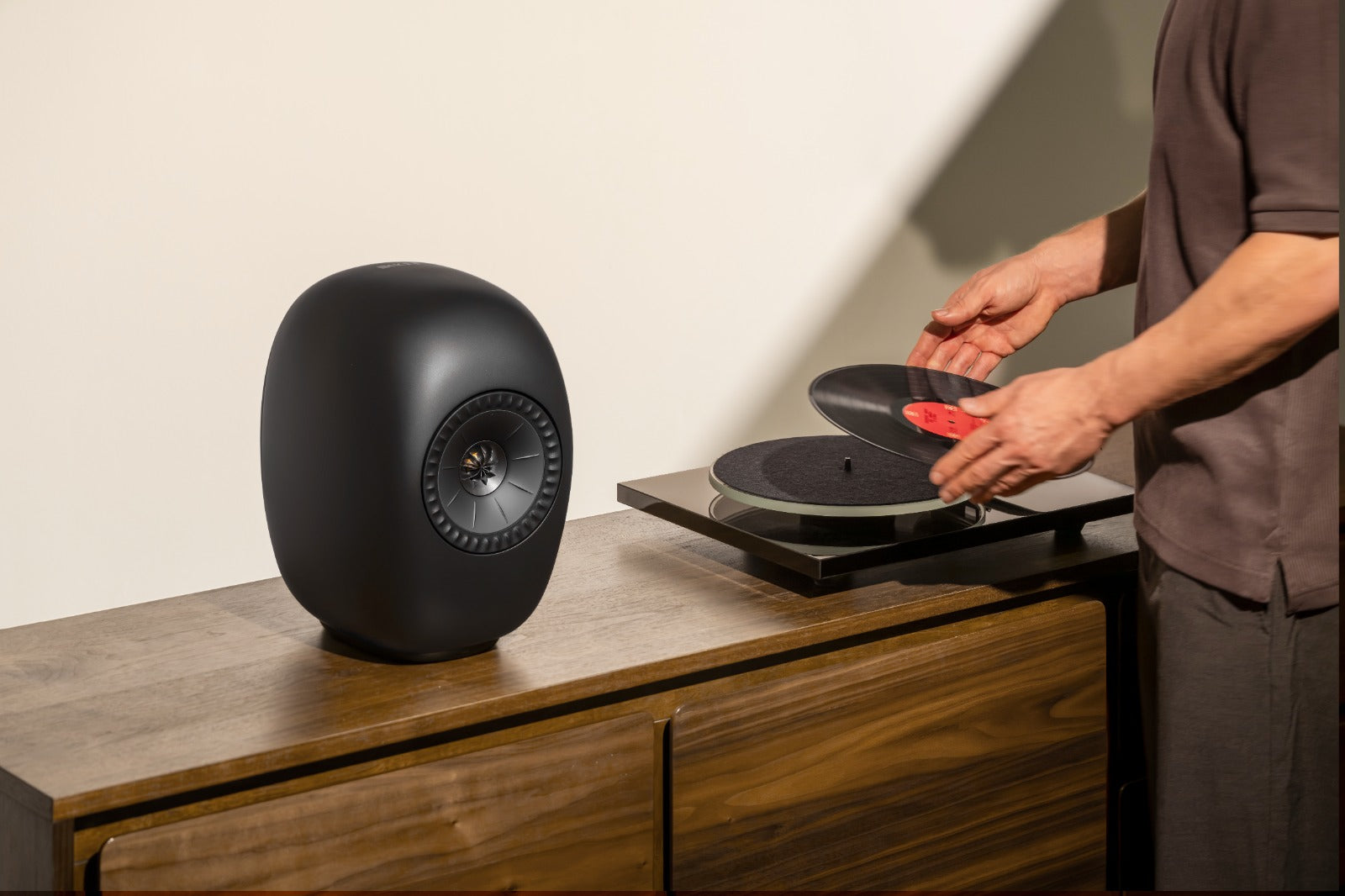
In most of the projects we work on, the brief for audio is the same: make it disappear. In-wall speakers behind acoustically transparent fabric. Ceiling drivers flush with the plaster line. Subwoofers buried in joinery. For a lot of spaces that is exactly right, and it is most of what we do in residential audio visual.
KEF's new LS LUXE is built on the opposite assumption.
Designed in collaboration with industrial designer Ross Lovegrove, it is a wireless speaker system intended to sit in the room as an object, not vanish into it. Whether that is useful to you depends entirely on the space you are specifying, so it is worth being precise about where it fits and where it does not.
What KEF has actually built
LS LUXE continues a partnership between KEF and Lovegrove that previously produced the Muon loudspeaker, the Mu headphones and the Muo portable speaker. The cabinet is soft-edged with an uninterrupted surface: no visible drivers, no exposed controls, no grille to break the line.
That matters acoustically as well as visually. KEF shapes the enclosure to reduce diffraction and vibration, and uses a flexible decoupling chassis to isolate the driver assembly. Claimed frequency response is 35Hz to 47kHz.
Behind the surface sits KEF's 12th-generation 6.5-inch Uni-Q driver array with Metamaterial Absorption Technology, which absorbs unwanted rear output from the tweeter to reduce distortion. Uni-Q's coincident arrangement is designed to spread sound evenly across a room rather than concentrating it into a single seat, which is the more relevant point for a living space where nobody sits in the acoustic centre.
New to this category is KEF's Velocity Control Technology, or VECO. It monitors the Uni-Q driver in real time and feeds that back to a custom amplifier to correct movement inconsistencies, targeting tighter bass and lower distortion. Amplification is 100W Class AB plus 280W Class D per speaker.
Why this is a specification question, not a product question
Here is the practical issue we run into on residential and hospitality projects in the UAE.
A designer specifies a beautiful room. The AV requirement arrives late, usually after joinery is fixed and often after the ceiling is closed. At that point the only honest options are compromise the acoustics to protect the design, or compromise the design to protect the acoustics. Neither conversation is enjoyable.
A speaker like LS LUXE removes that trade-off in a specific set of cases:
Rooms where you cannot cut in. Heritage properties, glass-heavy penthouses, apartments with structural constraints, or fit-outs where the ceiling void simply is not there. In-wall and in-ceiling stop being available and a floor-standing object becomes the only route to serious performance.
Rooms where the audio should be part of the composition. A gallery-style living space, a hotel suite, a yacht saloon, a showroom. If the room already reads as curated, a well-designed object adds to it rather than interrupting it.
Projects where the AV brief arrives late. LS LUXE needs power and a network. It does not need a first-fix cable schedule. That flexibility is worth a great deal when the programme has already moved on without you.
Where it is not the answer: dedicated cinema rooms, whole-property distributed audio, anything requiring multiple zones from a central rack, or any space where the design intent is genuinely for the technology to be invisible. Those remain in-wall and in-ceiling territory, and we would specify accordingly.
Connectivity, and why it matters for hospitality
LS LUXE runs on KEF's W2 Wireless Platform with native streaming from Tidal, Qobuz, Amazon Music and Deezer, plus Spotify Connect, Tidal Connect, QPlay, AirPlay and Google Cast. It supports lossless formats up to 24-bit/384kHz and multi-room playback.
For wired sources there is HDMI eARC alongside analogue, optical and coaxial inputs, and each speaker carries a dedicated subwoofer output. It will also stream from a local NAS or music server, including PCM and DSD libraries.
The eARC input is the detail worth noting for suite and villa work. It means the same pair handles television and music without a separate soundbar or a second system in the room, which reduces both the equipment count and the number of remotes a guest or client has to understand.
Setup and room EQ run through the KEF Connect App, which offers Normal and Expert modes. A C3 remote is supplied, with an aluminium top plate, backlit buttons and a customisable favourite button.
Finishes and accessories
LS LUXE is available in Dusk Titanium, Eclipse Black and Mineral White. KEF also offers matching S-LUXE floor stands with integrated cable management, the K-Stream interspeaker cable for runs up to eight metres, and the KW1 wireless subwoofer adapter for pairing with compatible KEF subwoofers.
The eight-metre cable run is the number to hold on to at design stage. It sets the maximum separation between the two cabinets, which in turn constrains how wide the stereo pair can be placed in a large open-plan space. Worth checking against the plan before the speakers are committed to a layout.
How we would approach it
We would not specify LS LUXE from a brochure, and we would not ask you to. The point of a speaker designed as an object is that it has to work in the actual room, against the actual finishes, at the actual listening distance.
Our showroom in Al Quoz is set up for exactly that: hearing a system in a real environment rather than reading about it. For designers and architects working on a live project, we can also review the space at design stage and tell you honestly whether this is the right route or whether an integrated solution serves the room better.
Sometimes the answer is that the speaker should disappear after all. We would rather say that early than after the ceiling is closed.
Start your project with us and we will talk through the room before we talk through the equipment.


