
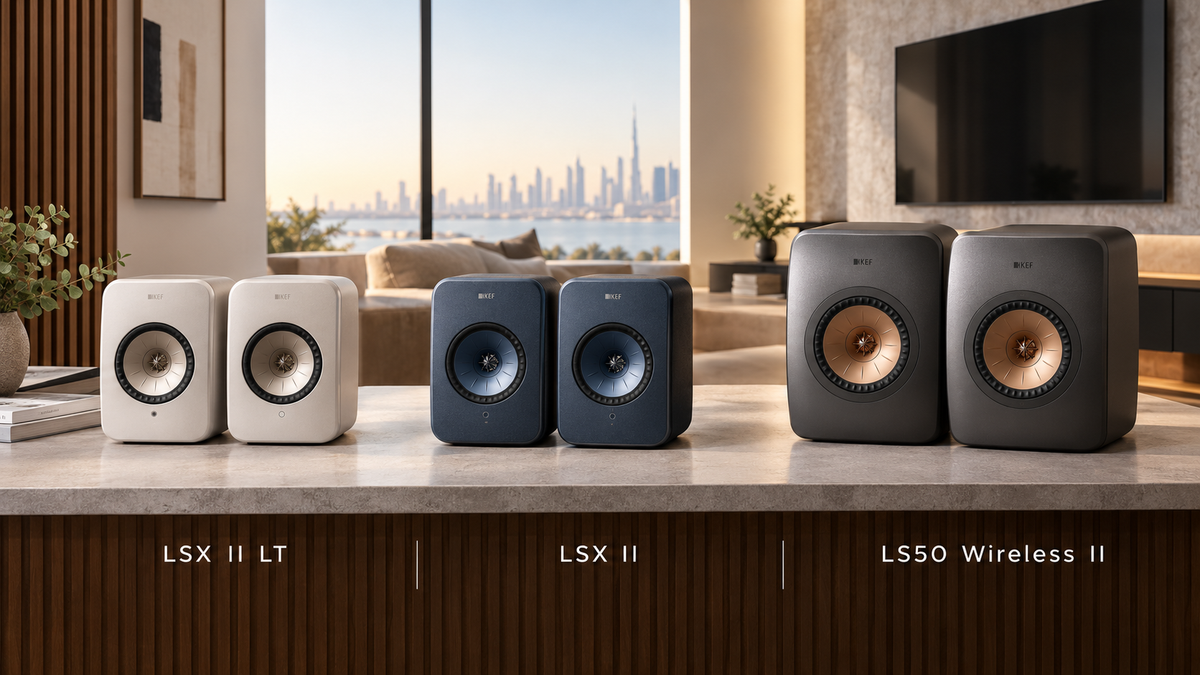
KEF's wireless range holds three models below the LS60, and the naming makes them look far closer than they are. The short answer: the LSX II LT and LSX II share almost everything internally, while the LS50 Wireless II is a genuinely bigger speaker built for a bigger room.
KEF LS50 Wireless II vs LSX II vs LSX II LT at a glance
|
|
LSX II LT |
LSX II |
LS50 Wireless II |
|
Uni-Q generation |
11th |
11th |
12th with MAT |
|
Mid-bass driver |
115mm |
115mm |
130mm |
|
Amplification |
200W total |
200W total |
380W per speaker |
|
TV input |
HDMI ARC |
HDMI ARC |
HDMI eARC |
|
Analogue input |
No |
3.5mm |
RCA line |
|
Roon Ready and MQA |
No |
Yes |
Yes |
|
Finishes |
3 |
5 |
4 |
|
Best room size |
Up to 25-30m² |
Up to 25-30m² |
30-50m² |
Start with the driver, not the price
The LSX II LT and the LSX II both use the 11th-generation Uni-Q array: a 19mm aluminium dome tweeter mounted at the acoustic centre of a 115mm magnesium and aluminium alloy mid-bass cone, with 200W of Class D amplification across the pair.
The LS50 Wireless II steps up to the 12th-generation Uni-Q with Metamaterial Absorption Technology, a larger mid-bass driver and substantially more amplification per speaker. MAT is a maze-like structure behind the tweeter that absorbs sound radiating backwards from the dome, which would otherwise pass back through it as distortion. The result is a cleaner, less fatiguing treble, and the difference shows two hours into a session rather than in the first two minutes.
That is the real dividing line. LSX II and LSX II LT are the same speaker with different feature sets. The LS50 Wireless II is a different class of product.
LSX II vs LSX II LT: what does the LT give up?
Both share the driver array, amplification, W2 streaming platform and cabinet size of 24 x 15.5 x 18cm. Both offer HDMI ARC, optical, USB-C and a subwoofer output.
The LT gives up four things:
-
The 3.5mm analogue input. No wired connection for a turntable with its own phono stage, or any legacy analogue source.
-
Roon Ready certification and MQA playback. If you run a Roon library, this alone decides it.
-
aptX Bluetooth. Standard Bluetooth remains.
-
The cloth-wrapped cabinet. Three finishes rather than five, in a plainer painted enclosure.
The LT also links its two speakers with the supplied USB-C cable rather than wirelessly, so the two positions must be within cable reach.
If you stream over Wi-Fi and connect the TV over HDMI, the LT delivers the same sound for less. If you run Roon, want an analogue input, or finish quality is part of the brief, the LSX II earns the difference.
Which room size suits which speaker?
Bass extension is what decides this. The compact pair rolls off in the low fifties of hertz, while the LS50 Wireless II reaches into the forties with noticeably more output behind it. That gap is small on paper and obvious in a large room.
A compact pair like the LSX II or LT is at its best in a study, bedroom, home office or on a desk, and covers roughly 25 to 30 square metres before it starts asking for help. In a Dubai apartment, that suits most second rooms.
The LS50 Wireless II is a living room speaker. It reaches lower, plays louder without strain, and uses HDMI eARC rather than ARC, which matters if you want higher bandwidth audio sent back from a modern television rather than compressed stereo.
Above both sits the LS60 Wireless, a floorstanding system with 1400W of amplification across dedicated high, mid and low frequency amplifiers, for large open-plan villa living rooms.
Where do they need to sit?
These are rear-ported speakers, so they need breathing room behind them. Pushed tight against a wall or into a bookshelf recess, the bass turns thick and the imaging collapses. Leave at least 20cm where you can, and use the app's EQ to compensate where you cannot.
The LS50 Wireless II also needs proper stands at ear height, which is a real cost to budget for rather than an afterthought. The LSX II and LT are happy on a desk, a sideboard or KEF's own stands and wall brackets.
Does the connection type affect sound quality?
Yes, at the margins. Streaming over your network handles the highest resolutions, the USB-C and optical inputs sit a step below, and HDMI ARC is the most limited of the three for pure audio.
Running the two speakers wired to each other rather than wirelessly also raises the ceiling on what passes between them. For most listening the difference is inaudible, but if you have a hi-res library it is worth running the cable.
Do not skip the subwoofer question
All three have a subwoofer output, and all three benefit from it. Adding a subwoofer to a compact pair very often does more than spending the same money moving up a model.
The KEF Kube 8 MIE is the natural partner for an LSX II or LT, with an 8-inch long-throw driver, 300W Class D amplification and a sealed cabinet that keeps bass controlled rather than boomy, plus placement presets for free-standing, in-cabinet and corner positions. For a larger room with the LS50 Wireless II, the Kube 10b has more headroom.
Both can connect without a cable across the room using KEF's optional wireless adapter, which matters in a finished apartment.
What if the source is a turntable?
Neither the LSX II nor the LS50 Wireless II includes a phono stage. The KEF Coda W does, along with an RCA line input, HDMI ARC, optical and USB-C, 100W per channel and a larger Uni-Q array than the LSX II.
If vinyl is the main reason you are buying, the Coda W removes a box, a pair of interconnects and a power supply from the equation.
Setup and multi-room
All of these run through the KEF Connect app, which handles setup, streaming services and EQ. The EQ section is worth ten minutes: tell it whether the speakers are on stands or a desk, how far they sit from the wall, and the size and character of the room, and it applies a correction curve. In a room with marble floors and glass, the difference is not subtle.
Any combination of LSX II, LSX II LT, LS50 Wireless II and LS60 Wireless can be grouped through AirPlay 2 or Chromecast, so a pair in the study and a pair in the living room play the same source.
Frequently asked questions
Is the LS50 Wireless II worth the extra over the LSX II?
In a living room, yes. In a study or bedroom under 30 square metres, the LSX II with a subwoofer often makes more sense for the money.
Can I use these as TV speakers?
Yes. All three have an HDMI connection to the television and switch on with it. The LS50 Wireless II uses eARC, which carries higher bandwidth audio than the ARC connection on the LSX II models.
Do I need a streamer or amplifier with them?
No. Amplification, streaming and processing are built in. You need power and a network connection.
Is the LSX II LT worth the saving over the LSX II?
If you stream over Wi-Fi and use HDMI, yes. If you need an analogue input, Roon or aptX Bluetooth, no.
Can I add these to an existing KEF system?
Yes. Any of the LS Wireless models can be grouped with each other over AirPlay 2 or Chromecast for whole-home playback.
Do they work with Alexa or Google Assistant?
They are not voice assistants themselves, but they can be controlled through a smart speaker or integrated into a home automation system with voice control.
All three are set up for demonstration at our Al Quoz showroom, which is the only way to settle a comparison like this properly.


